A collector-built app that parses set codes and treats every alt art as its own line item surfaced on r/ONEPIECETCG, and OP01's top SEC is the reason variant granularity matters.
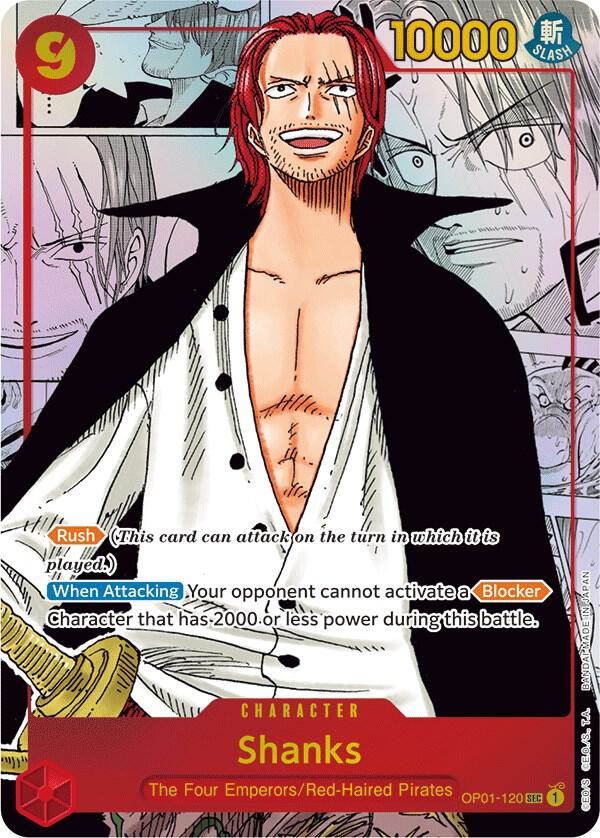
Shanks OP01-120, flat at $3,998.74
A developer posted on r/ONEPIECETCG this weekend looking for testers for ChaseBinder, a multi-game collection app that reads the set-and-number code printed on a card and, critically for this game, logs every alternate art as a separate entry rather than folding it into the base print. One Piece is one of six games it covers. The reason that design choice matters is sitting at the top of this page: the manga parallel Shanks (Parallel) (Manga) (Alternate Art) trades at $3,998.74, while plenty of OP01-120 printings do not.
$3,999.74 · the all-time high this Shanks sits just under
The chart above is about as quiet as a four-figure card gets. Seven-day change: zero. Thirty-day change: zero. The card is parked a dollar below its record, which is less a sign of momentum than of a market that has agreed on a number and stopped arguing about it.
Raw against the slab
A PSA 10 copy runs $4,475.50, a multiple of 1.1 over the raw price. That is a thin graded premium for a card in this bracket, and the population file explains why: 1,858 copies submitted with an 86 percent gem rate. When nearly nine in ten submissions come back a 10, the slab stops being scarce and starts being a shipping label.
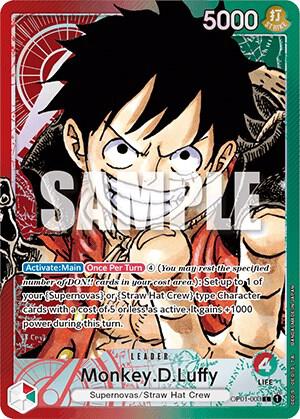
Compare that to Monkey.D.Luffy (003) (Parallel) at $1,042.78 raw, where the PSA 10 carries a 5.8 multiple against a somewhat lower 83 percent gem rate across 2,561 graded copies. Same set, same era, wildly different relationship between raw and graded. An app that lumps variants together cannot show you that gap; an app that splits them can.
The rest of the set
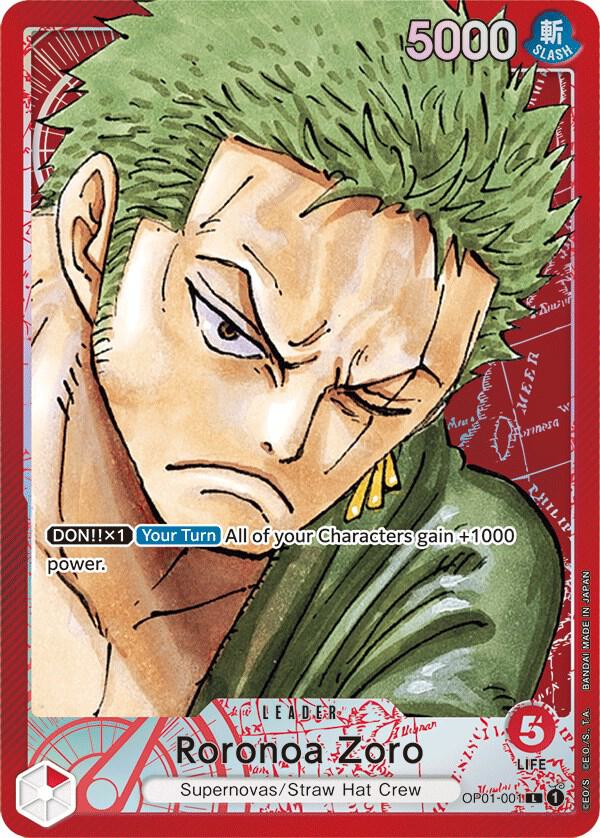
OP01 is 48 months old and still the deepest board in the game. Below Shanks and that Luffy sit Roronoa Zoro (001) (Parallel) at $625.67, up 2 percent on the week but off 5.3 percent on the month, then Trafalgar Law (002) (Parallel) at $463.37 and Nami (Parallel) at $461.20.
Sealed is its own planet. A Romance Dawn box marks at $4,298.93 against an original MSRP of $100.56, a 42.7 times multiple, which works out to $179.12 per pack. Expected value on that box is $430, an EV ratio of 0.1. Every box in this game is negative EV by design, but a ratio that low is what happens when sealed product becomes an artifact rather than a way to open cards. Roughly 165,480 boxes are estimated opened, feeding 52,401 graded cards at an 83 percent gem rate. Our Long-Term Score for the set reads 6 out of 10, Moderate.
The return picture splits by timeframe. From MSRP, sealed has compounded 158 percent annualized. Over the past year, 45 percent. Over the past three months, the annualized rate is negative 53 percent, which is the sort of divergence that makes single-number summaries useless.
Where this leaves it
The tracker news does not move a price, and nothing here suggests it should. What it does is underline a structural quirk of this game: the gap between a base print and its manga parallel can be two orders of magnitude, and inventory tools that treat OP01-120 as one card are quietly misreporting portfolios.
Shanks, meanwhile, remains the cleanest expression of that quirk. Flat on the week, flat on the month, a dollar off its high, with a graded premium of 1.1 that says the market has already priced the slab in. The set's broader graded premium is 1.9, for context. If you want to see how the rest of the board is behaving, the screener and the EV page are the better starting points.
 ONEPIECE TERMINAL